
 Motivated by the adverse environmental and societal effects of fossil resources, efforts to defossilize the energy, mobility and chemical industries have sought alternatives based on, among others, solar power. Thus, solar-to-X technologies achieve energy and chemical conversion within a single device, thereby being in principle able to reach high efficiencies while also having the potential to be deployed in a decentralized manner, towards realizing the vision of a local energy and chemicals production system with on-site resource provision. Yet, there are significant challenges to overcome at the fundamental level (physics and chemistry) as well as at the practical implementation level (device engineering). In addressing these challenges, trial-and-error experimentation, as well as incremental improvements in device and process design, can be resource-intensive, time-consuming and do not guarantee results, given the vast materials design space and the potential integration challenges at the device level. On the other hand, fundamental understanding supported by theory and simulation represents a unique opportunity to obtain valuable insight into the underlying physico-chemical processes, and drive innovation towards effective solutions, which optimize the intrinsic performance of the material and the overall performance of the device.
Motivated by these challenges and opportunities, PREDICT, funded by the HORIZON-EIC-2024-PATHFINDERCHALLENGES-01-01 call, and aims to accelerate innovation in the development of solar-to-X technologies by addressing the following high-level objectives:
- Advance existing modeling approaches at scales ranging from the electronic to the macroscopic, with particular emphasis on quantum mechanical (QM) methods for efficient calculations of excited state structures and excited state dynamics.
- Integrate the pertinent modeling approaches into a holistic framework and user-friendly, general-purpose software for first-principles-based multiscale photo(electro)chemical (PEC) materials and process design from electrons to devices.
- Elucidate fundamental mechanisms underpinning the performance of PEC CO2 reduction devices to hydrocarbons and alcohols using advanced computational materials science techniques.
- Validate the models and guide the development of innovative devices and processes for solar-to-X conversion via collaborations with experimental partners.
These objectives are addressed via a research and innovation program involving 12 work-packages (WPs).
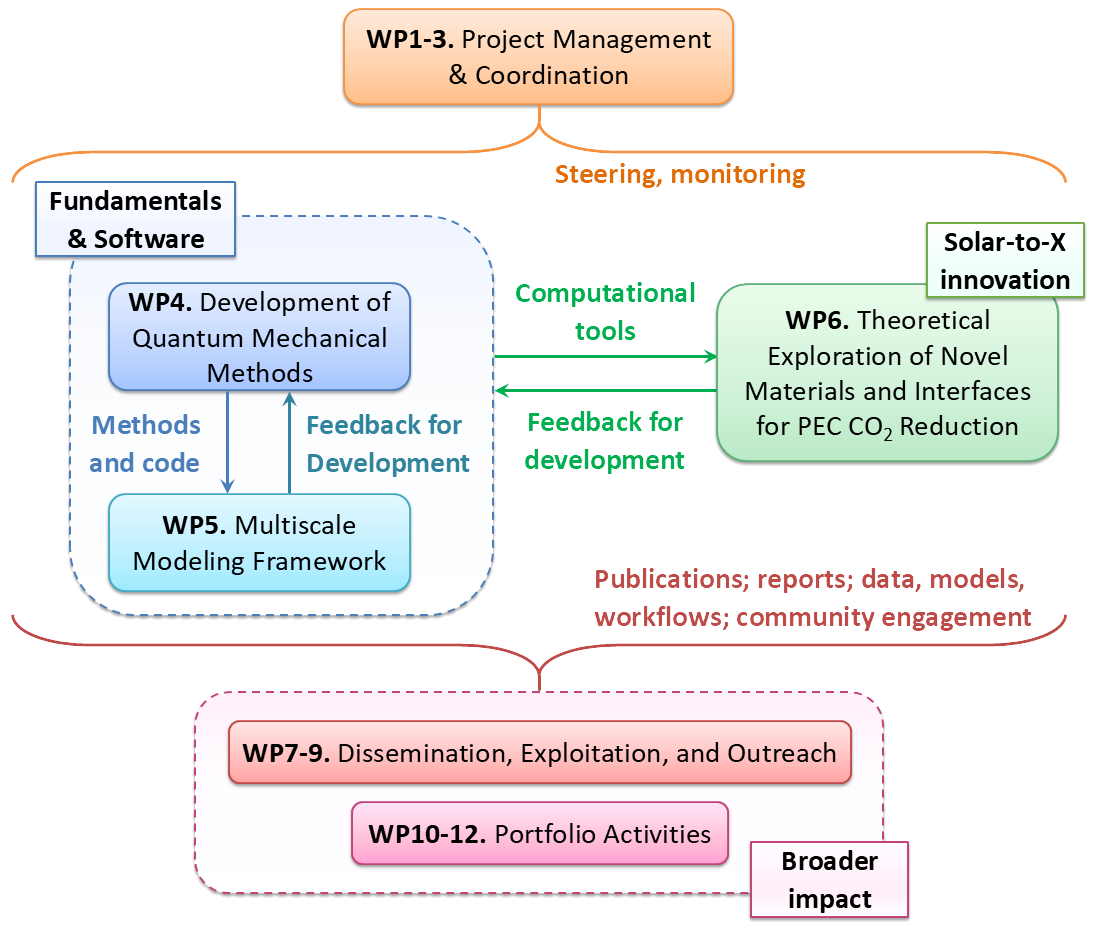
WP1-3 entail project management and coordination activities. WP4 focuses on developing novel but also enhancing existing quantum mechanical approaches for calculating excited states, thereby enabling detailed studies of photoelectrochemical (PEC) systems. WP5 achieves the multiscale integration of methods at all the relevant scales: electronic/atomistic (quantum mechanics (QM)), mesoscopic (statistical mechanical, kinetic Monte Carlo (KMC)) as well as macroscopic (computational fluid dynamics (CFD)). The methods, computational code and workflows generated in WP4 and WP5, feed into WP6, which revolves around model- based innovation on realistic PEC materials and systems of interest in solar-to-X. Finally, WP7-9 and WP10-12 are an integral part of PREDICT's impact strategy and will focus on engagement with other Consortia funded by the HORIZON- EIC-2024-PATHFINDERCHALLENGES-01-01 call, as well as the broader academic and industrial community.