
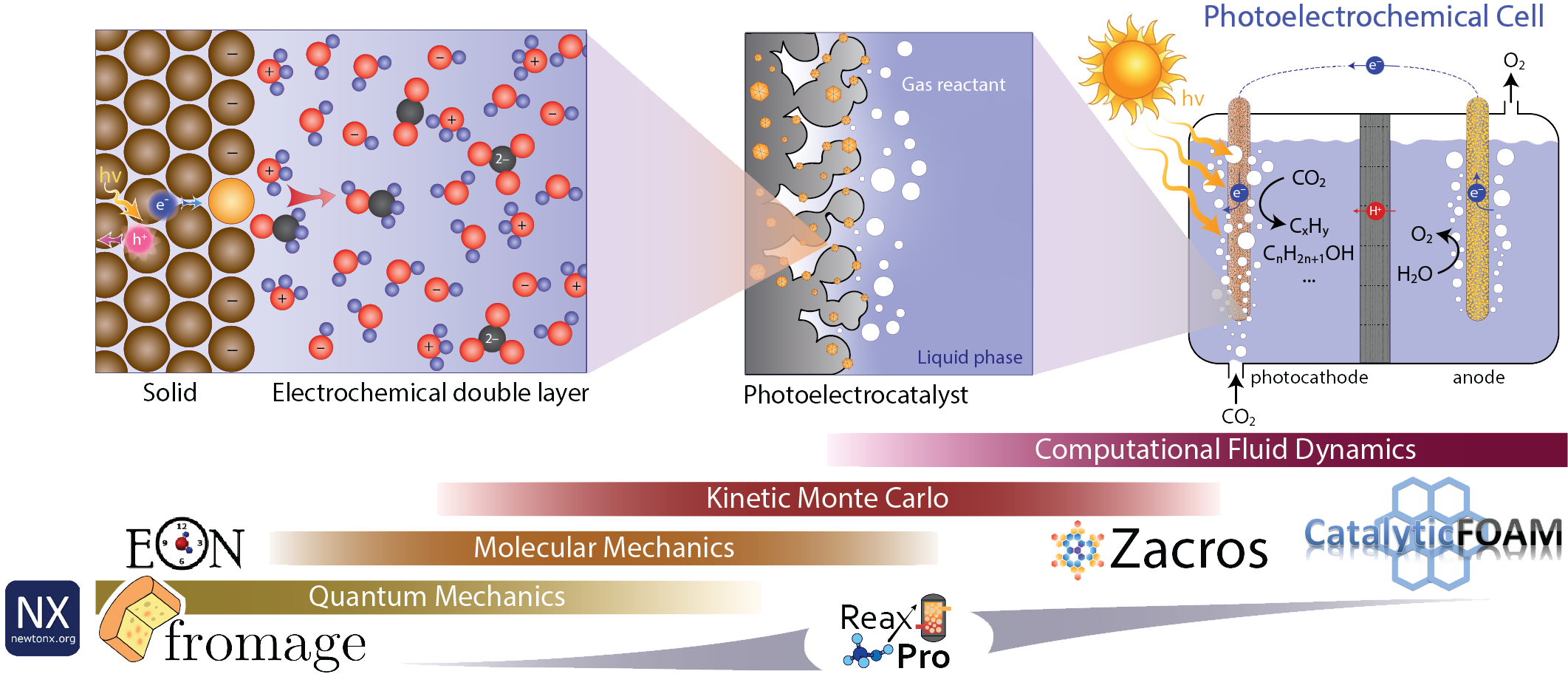
PREDICT develops a software platform for modeling photoelectrochemical (PEC) materials and processes, which integrates improved quantum-chemistry methods, as well as atomistic, statistical mechanics – kinetic Monte Carlo (KMC) and computational fluid dynamics (CFD) approaches, to underpin innovation in the development of solar-to-X technologies for CO2 conversion into valuable products.
Substantial know-how on PEC materials and processes has been accumulated in academia and industry in recent years leading to a number of proposed concepts for harvesting solar energy and converting it to fuels and chemicals in a sustainable way. However, in several of these concepts, solar-to-energy conversion is decoupled from the chemical conversion steps, which leads to efficiency losses. Integrated solutions are much desired, but come with their own set of challenges, overcoming which necessitates a detailed understanding of the underlying physics and chemistry and relies on holistic modeling approaches that integrate high-fidelity descriptions of the relevant phenomena into a framework that can support innovation at the device level. However, currently, an integrated / holistic modeling framework for PEC process and device design is lacking.
Thus motivated, the key novel concepts behind PREDICT are:
- The integration of modeling approaches, each targeting a specific scale of a PEC process from the electronic to the macroscopic, into a framework that can be used in process design from first-principles.
- The consideration of the kinetics of all relevant processes, including electron-hole generation via photo- excitation, diffusion and recombination of electrons and holes, charge extraction, chemical steps (adsorption, desorption, surface diffusion and reaction), as well as mass transport limitations at the meso- and macro-scales.
- The improvement of the speed and accuracy of quantum chemistry calculations with the further development of novel methodologies that go beyond the frequently used time-dependent DFT (TDDFT).
PREDICT is planned for a duration of 48 months and brings together 6 academic institutions (Oxford, UCL, University of Iceland, National Technical University of Athens, Politecnico di Milano, Politecnico di Torino) and 1 commercial partner (Toyota Motor Europe) in 5 countries across Europe. Read more about the project structure and the project partners.